
Juanita Mummy
 Juanita Mummy is Arequipa‘s most globally famous attraction. She is believed to have been a sacrificial offering by Inca priests to the volcano Ampato, where she remained buried in snow for over 500 years.
In 1995, the scholar Johan Reinhard, a specialist in high altitude archaeology, discovered Juanita’s well-preserved remains shortly after the eruption of a neighboring volcano melted the ice that encased her tomb high atop the Ampato’s Mountain. Scientific study of the Juanita mummy remains and including DNA analysis, have afforded great insights into Inca culture.
Location
The Juanita mummy is located in the Andean Sanctuaries Museum of the Catholic University of Santa María, located just off the Plaza de Armas in Arequipa.
Which is stored in a special freezer, protected from the environment by a vacuum-sealed glass chamber. The urn is secured with steel profiles and has two layers of plexiglass inside. The interior of the urn is at a temperature of -19ºC, to avoid dehydration of the corpse.
History of the Mummy Juanita
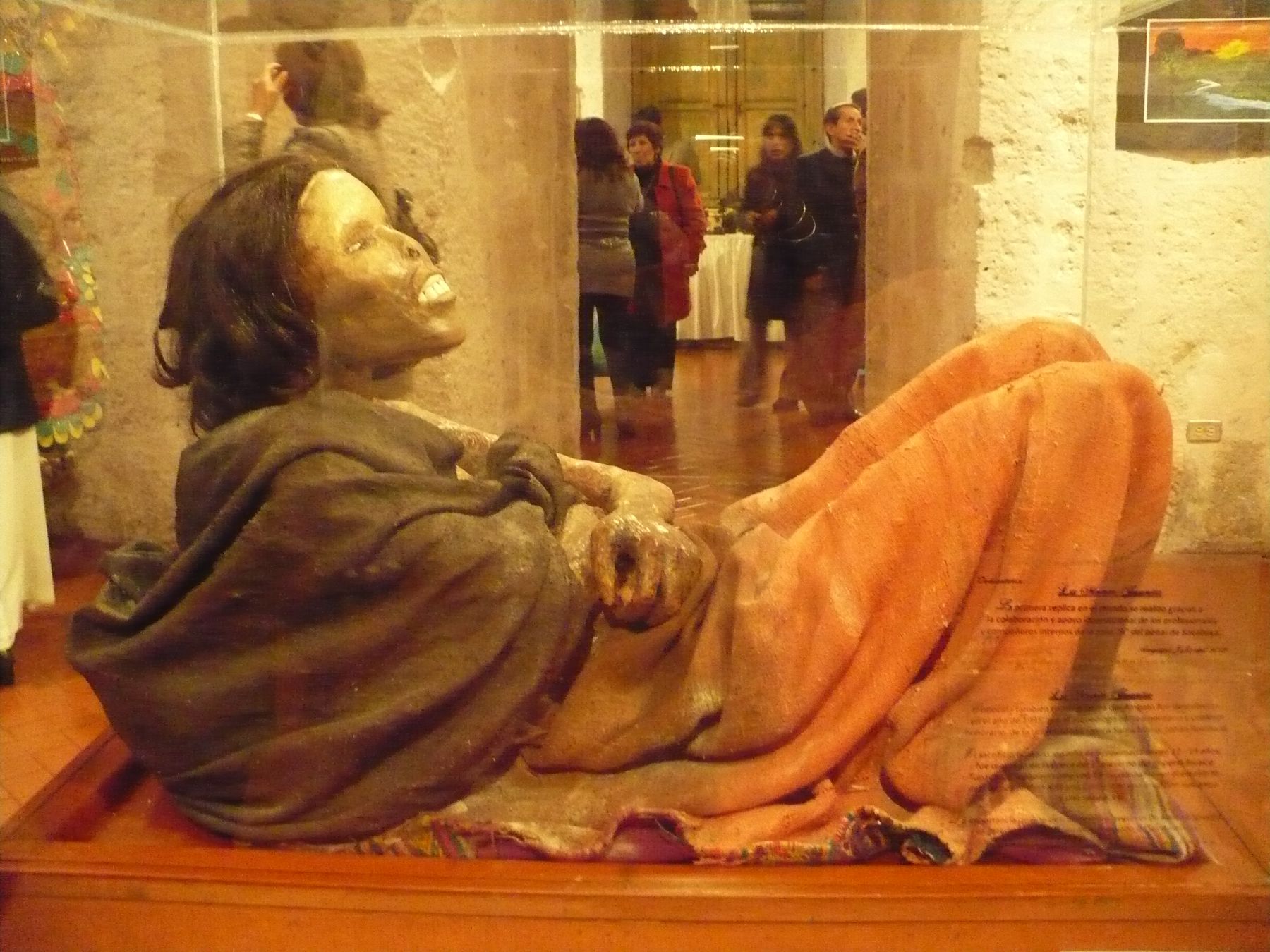 Juanita was a virgin maiden from the Inca era. In the 15th century, when she was between 12 and 15 years old, she was chosen along with other young women from the Andean region to be sacrificed in gratitude to Pachamama or Mother Earth (It was then considered a privilege at that time).
According to experts, Juanita was murdered during an Inca sacrifice known as Capacocha, carried out on the Ampato volcano, more than 6,300 meters above sea level. This ritual was performed to calm Pachamama, avoid natural catastrophes and guarantee a good harvest.
Discovery of the Juanita Mummy
 In 1995, American anthropologist Johan Reinhard climbed the Ampato volcano in Arequipa located at about 6,288/20,630 feet. He and his companion on the expedition, Miguel Zárate, came across a lump inside a crater, probably fallen from an Inca cemetery at the summit.
The two men took the frozen bundle to the Universidad Católica de Santa María in Arequipa, where it weighed 90 pounds (40.82 kg). The body of the sacrificed girl was named Juanita, and she is also known as the Lady of Ampato or the Maiden of Amabato. She was found with several artifacts around her, including a llama figure and pottery.
In subsequent expeditions to Nevado de Ampato, other frozen mummies were found, including a boy and a girl found in October 1995 and a female mummy in 1997.
Preparation for Juanita’s Death
 Juanita’s life before her selection for human sacrifice was probably not unusual. However, the days before her death were very different from her lifestyle of a typical Inca girl. Scientists were able to use Juanita’s well-preserved hair DNA to create a timeline of those days and deduce what her diet was like before the capacocha (Qhapaq Hucha).
Evidence from Juanita’s hair indicates that she was selected for sacrifice approximately a year before her actual death and switched from a normal diet of potatoes and vegetables to more elite foods of animal protein and maize, along with large amounts of coca and alcohol (chicha).
Thus archeologists believe that upon Juanita’s death, she was likely in a very docile and relaxed state. While the Incas would eventually perfect this drug (plants) mixture — which, coupled with the mountainous high altitudes, would cause the child sacrifices to fall into a permanent sleep.
