
Macaw clay licks Of The Peruvian Amazon
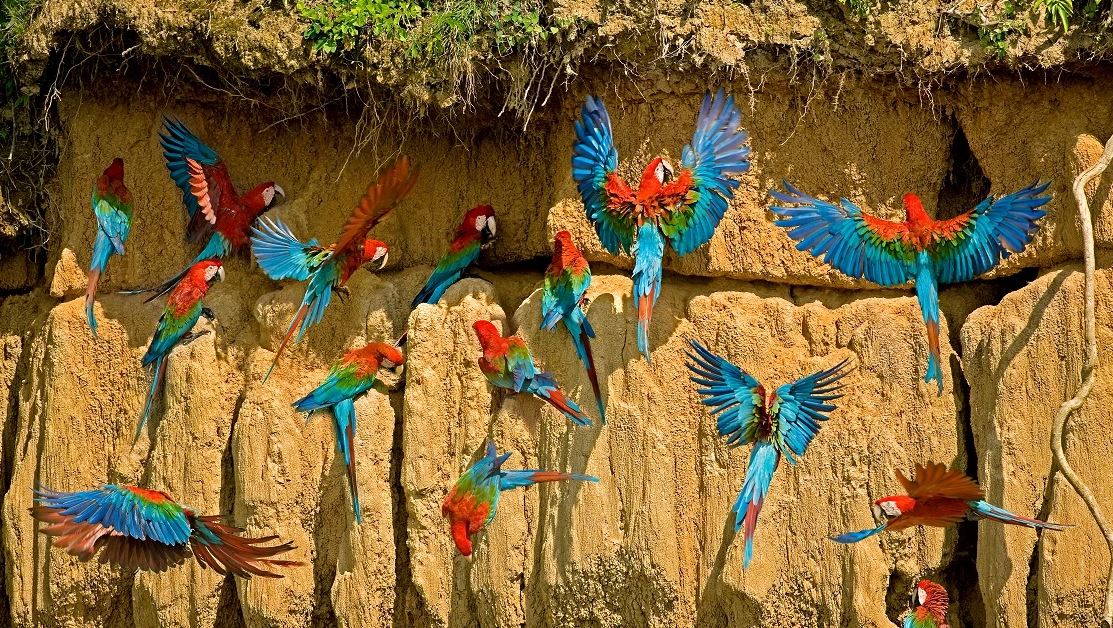 The famous Macaw clay licks of the Peruvian Amazon: exotic parrots like macaws gather here daily to eat the clay, creating the perfect destination for travelers to observe a lots of individual parrots that flock here. But what is a clay lick exactly and why do parrots (and indeed other animals) eat clay? What attracts them to these clay licks in the first place? For a bit of insight into this bizarre phenomenon, here are the main hypotheses.
What is a Parrot Clay Lick? The Clay licks (or collpas as they are known in the Amazon) are zones of clay deposits in the rainforest where animals and birds congregate to consume the clay by licking at it. Avian clay licks are often found on the outer bends of meandering rivers where erosion of the riverbank has exposed clay seams in the soil.
Why do macaws eat clay?
Macaws, parrots, and parakeets that visit the clay licks in Manu National Park in Peru are thought to eat clay to help them neutralize toxins consumed in their daily diets. Other macaws, parrots, and parakeets outside this region, and in other parts of the world, have similar diets but never eat clay nor visit clay licks. The possible reason(s) these birds chew and eat clay still remains largely unanswered.
Start of the natural show.
Parrot collpa activity typically begins shortly before dawn, when the first parrots approach the collpa area, usually in pairs as they call, and then land on the trees around the lick. It is understood that they perch on the higher branches while waiting for the rest of parrots to check if there are predators in the area.
Little by little, the trees are filled with more and more parrots. After a while, they start to fly slowly in circles in front of the lick or descend to some area of vegetation that is lower and once they feel sure that there are no predators, they congregate in groups in the lick to consume the clay .
Once they have finished, or if they perceive any threat, they will vanish with a rainbow of colors and a cacophony of calls.
Where you Can See a Parrots Clay Lick?
 The Clay licks can be found throughout the Amazon Rainforest, but visible and accessible ones are best visited on Manu tours of Peru and Ecuador. Here is a list of the most famous Amazon clay licks:
1.- Blanquillo Clay Lick in Manu National Park, Peru
 The Blanquillo Clay Lick in Manu National Park is a popular spot to witness this unusual animal behavior. Rainforest parrots congregate at this one bend along the Manu River, feeding on only one specific layer of soil that runs for hundreds of meters horizontally along the bend.
2.- Chuncho Macaw Clay Lick in the Tambopata National Reserve, Peru
 Tambopata has the highest concentration of avian clay licks in the world, including the world’s largest clay lick: the Chuncho Macaw Clay Lick. A true sight (and sound) to behold, here more than 20 different tropical bird species perch, preen and peck at a cliff of clay, from tiny parakeets to Mealy parrots and huge (and noisy) Red and Green Macaws.
3.- Yasuni Clay Licks – Yasuni National Park, Ecuador
The Anangu Community territory within the Yasuni National Park is home to over a dozen clay licks. Two of the most accessible and spectacular ones can be found along the Giant Otter Creek.
Many of the 20 species of parrots, macaws, and parakeets found in the Ecuadorian Amazon can be seen here and in the best weather conditions sometimes 800 individual birds can be seen! The clay licks in Yasuni can be visited on Amazon river cruises in Ecuador and jungle lodge stays at either Sacha Lodge (on the shores of Lake Pilchicocha in the private Sacha Reserve), Napo Wildlife Center (up a tributary of the Napo River on Anangucocha Lake), or La Selva Lodge (on the Garzaocha Lagoon).
Whether you are a keen birdwatcher or just appreciate nature, the chance to visit the clay licks of the Amazon with a knowledgeable naturalist is one not to be passed up, one of the most stunning wildlife spectacles in the world that can’t be missed.
If you have already decided and want us to help you plan your Clay Licks trip, Contact us!.