
Inca Trail Ruins: 9 Amazing Sites You’ll See Along the Way
 Inca Trail Ruins were built over 500 years ago, the Inca Empire built a road system consisting of 40,000 kilometers (25,000 miles) of trails that stretched from north to south through Chile, Ecuador, and Peru.
It was so that they built one of the magnificent roads known as the Inca Trail to Machu Picchu is one of the most beautiful hikes in the world. Spanning an approximate 42 KM in distance and crossing through the splendor of the Andean mountains, the Inca Trail grants access to some of the most impressive Inca archaeological sites located in areas otherwise inaccessible.
The trail not only takes hikers along valleys and through mountain passes, but it also grants hikers access to the archaeological sites of Qanabamba, Llactapata, Runkurakay, Sayacmarca, Phuyupatamarca, Inti Pata, Wiñay Wayna and Intipunku. The Inca Trail leads directly to Machu Picchu and offers the hike of a lifetime.
1.- Wayllabamba
 The endpoint of the first day’s trek along the Classic Inca Trail, Wayllabamba (which means “grassy plain” in Quechua) is the perfect spot to watch the sunset behind the dramatic Andean peaks. This grassy plain overlooks stunning Andean scenery, with centuries-old Incan terraces winding through the surrounding mountainsides. There is even a village nearby where travellers can mingle with local villagers.
2.- Patallacta (Llactapata)
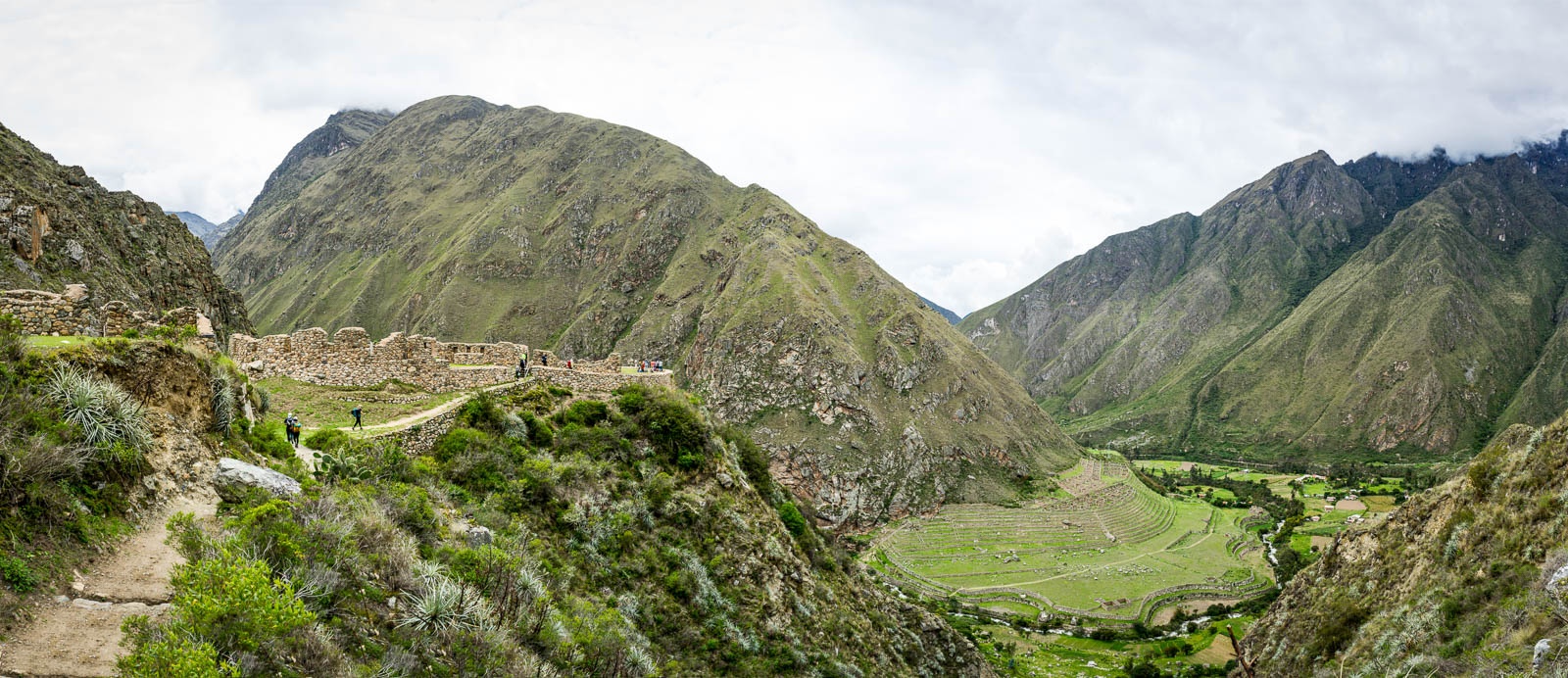 After only 6km (3.8 miles) of hiking, you will reach the first set of Inca Trail Ruins. known as Llactapata (sometimes called Patallacta) means ‘high city’ in Quechua. It consists of a ceremonial center, huge agricultural terraces, an urban center, and a cemetery. The complex sits at an altitude of 9,318 feet (2,840 meters) and contains massive terraces and hundreds of housing structures. It is believed this was a common stopping point for Incas traveling from Cusco to Machu Picchu. From your vantage point across the valley, you’ll be able to fully appreciate the site’s beauty and expanse.
3.- Runkurakay
 The Inca site of Runkurakay is known for its semicircular construction seemingly perched above the clouds. This complex is surrounded by thick vegetation and the towering mountain ranges that serve as the perfect backdrop. Based on its prominent location at 3,760 m.a.s.l., this site is thought to have served either as a resting place for travelers and pilgrims, or a control post.
This site is a perfect stop along the Inca Trail hike where you can enjoy magnificent views of the Inca trail, and explore the exquisite variety of flora and fauna.
4.- Sayacmarca
 This place was discovered by Hiram Bingham (Bingham also discovered Machu Picchu) when he wandered along a road extending from Machu Picchu, the dramatic Sayacmarca is situated at a fork in an old Incan Road, in a dense subtropical forest full of butterflies and hummingbirds. Quechua for “Dominant Town,” these unique ruins have a mystical air about them and are among the most impressive along the Classic Inca Trail.
It’s believed that Sayacmarca was actually built by the Colla, a major enemy of the Incas, and that the Incas took over the site following their conquest of the group.
5.- Phuyupatamarca
 After visiting the archeological site of Sayacmarca on Day 3 of the Inca Trail Peru, you will hike 2 hours up and down to Phuyupatamarca, which is the third highest point of the trail. It is known as the “Inca Ruins Among the Clouds” due to its unique misty scenery close to the jungle border.
Located at an altitude of 3,670m, right in the middle of the Inca Trail Cloud Forest, this amazing site offers incredible views of the entire valley with its enormous green mountains! There are some squares from which you can even admire other Inca sites of Peru, such as the Intipata or Wiñay Wayna ruins.
6.- Intipata Ruins
 Intipata (Sun Terrace) is located at 2840m (9318 ft) above sea level. It is one of the steepest and most impressive sets of terraces along the Inca trail. Crops like potatoes, corn, oca, quinoa, and coca leaves were grown here.
The site was one of many checkpoints along the trail. Its location provided a good surveillance point to observe travelers on their way to Machu Picchu. The hikers get to see this site after a long downhill hike at the end of day 3 on the Inca Trail.
7.- Wiñay Wayna
 The Inca site of Winay Wayna is one of the most impressive along the Inca Trail. Located at 3,800 m.a.s.l., Winay Wayna is only 6 KM away from Machu Picchu and serves as the last camping spot of the Machu Picchu hike. Just as in previous archaeological sites, Winay Wayna was built onto the mountainside.
There are terraces and enclosures all throughout the complex leading experts to deduce the possible uses of the site as a farming and administrative center. The site is complemented by a high waterfall and views of the Urubamba gorge and Apu Veronica.
9.- The Sun Gate (Inti Punku)
 On your final day, you will reach the Sun Gate of Machu Picchu. This famous arch is considered the finish line of the Inca Trail hike. For the Incan people, Inti was the Sun God, one of the most important deities in their belief system.
This structure was explicitly placed on a ridge on Machu Picchu’s eastern slope. During the Summer solstice, the sun passes directly through the arch. Regardless of your spirituality, witnessing this is a mesmerizing experience.
10.- Machu Picchu
 The enigmatic citadel of Machu Picchu is world-renowned and recognized for its architecture and historical importance. Named Cultural and Natural Heritage Site by UNESCO, Machu Picchu is without a doubt a prime example of ancient ingenuity and balance between nature and humans.
The Citadel of Machu Picchu is located at 2,400 m.a.s.l., between the high Andes and tropical rainforest, better known as cloud forest. It is rich not only in history but also in flora and fauna endemic to the region. To date, the exact purpose of the site is still a mystery. Its temples, terraces, walls, palaces, and enclosures leave visitors and experts with immense wonder.
Most visitors are left without sufficient words to describe the intricate constructions and precise rock shapes. The Inca Trail to Machu Picchu is one of the most emblematic travel experiences in the modern world. In contrast to any other hike in the region, the Inca Trail does not finish in the town of Aguas Calientes.
In fact, the Inca Trail is the only trail that leads directly into Machu Picchu via the imposing Inti Punku. As a result, the Inca Trail offers direct access to the mysteries of the Inca empire and some of the most exquisite views and landscapes of the region. Hiking to Machu Picchu via the Inca Trail should be on every traveler´s checklist. This hike is an example of the type of adventure that cannot be described just by words.
The Inca Trail hike along with all the archaeological sites found along the way have to be experienced in person to be fully embraced and understood.
