
Machu Picchu Circuit 3 or The Royalty Circuit
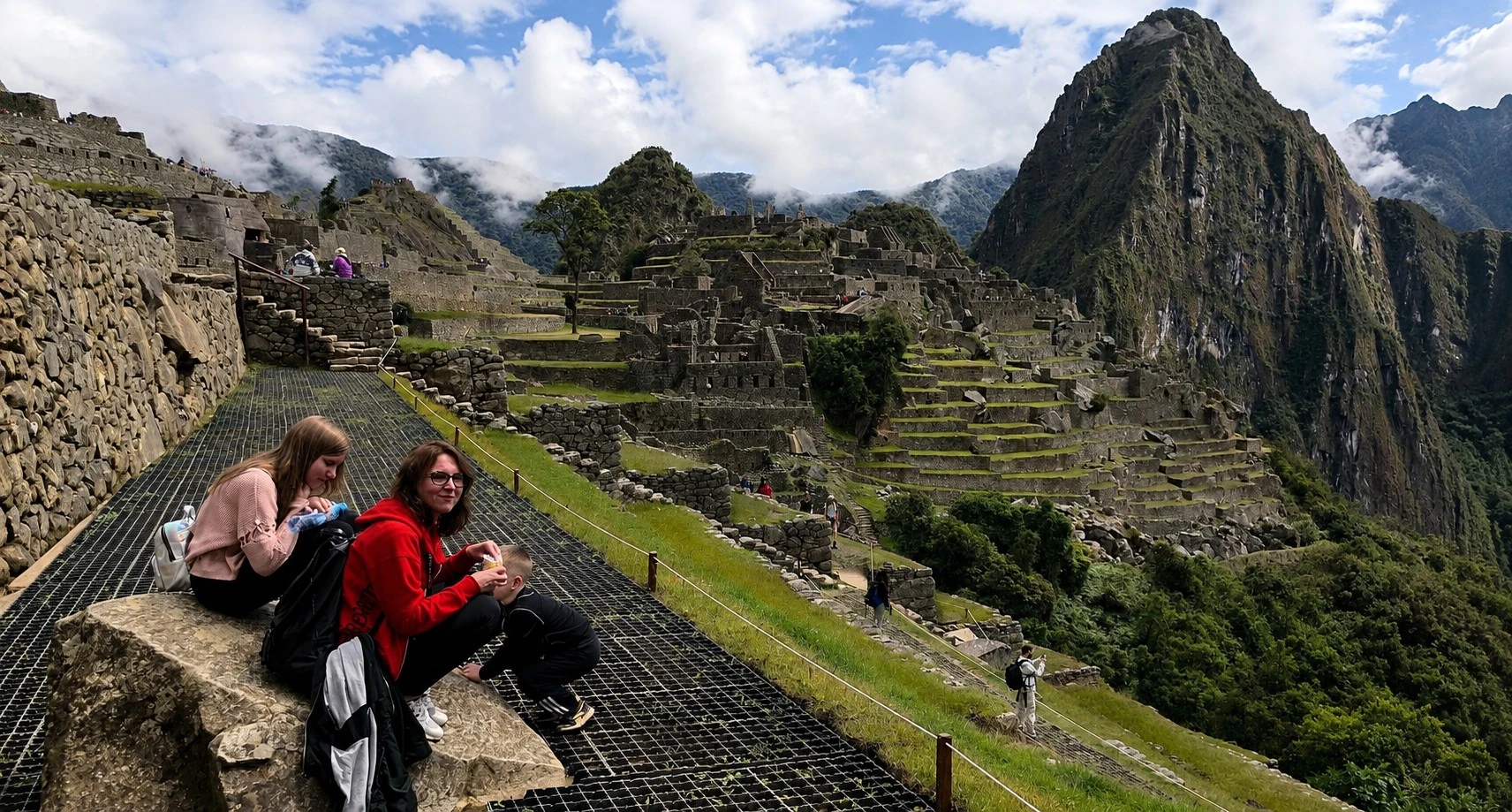 Machu Picchu Circuit 3 offers a unique way to explore the Inca citadel. Officially known as Machupicchu Realeza, this circuit focuses on the royal and lower sectors of Machu Picchu while offering several hiking experiences.
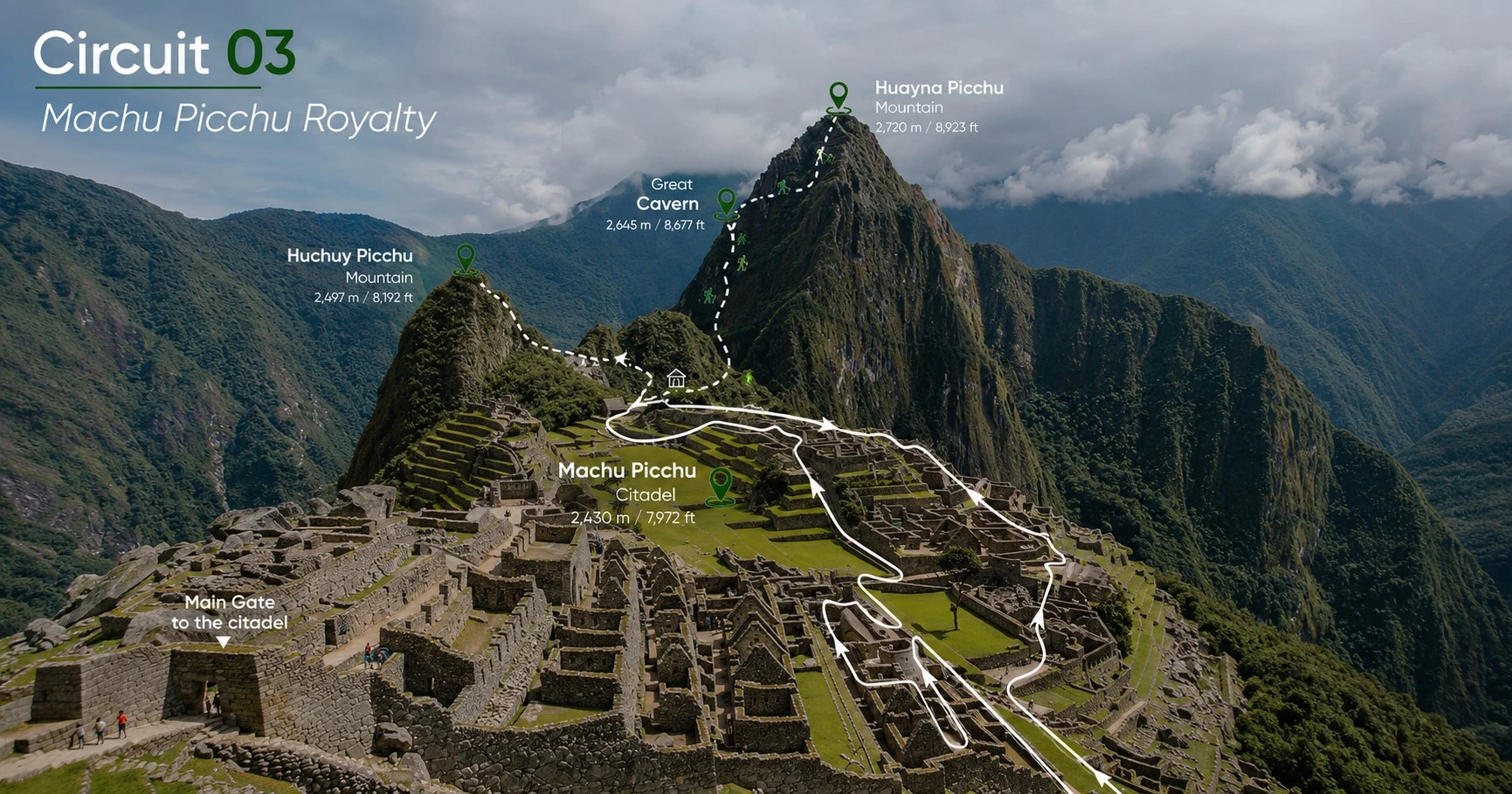
Travelers can choose between four routes: Route 3-A Huayna Picchu Mountain, Route 3-B Designed Route, Route 3-C Great Cavern, and Route 3-D Huchuy Picchu. Each route offers a different experience, so choosing the right one before buying your ticket is essential.
If you are planning a Machu Picchu Tour, this guide explains what Circuit 3 includes, how the four routes differ, and which option may be best for your trip.
What Is Machu Picchu Circuit 3?
Machu Picchu Circuit 3, officially called Machupicchu Realeza, is one of the three current visitor circuits at the Inca citadel.
It includes four routes:
- Route 3-A: Huayna Picchu Mountain
- Route 3-B: Designed Route
- Route 3-C: Great Cavern
- Route 3-D: Huchuy Picchu
The current system has been in effect since June 1, 2024, when Machu Picchu moved to three circuits containing ten visitor routes.
Circuit 3 is a good choice for travelers who want to combine archaeological exploration with hiking. However, it is important to know what type of view and experience each route provides before purchasing your ticket.
Machu Picchu Circuit 3 at a Glance
Route |
Main Experience |
Best For |
|---|---|---|
| 3-A | Huayna Picchu Mountain | Adventure and hiking |
| 3-B | Designed Route | Archaeological exploration |
| 3-C | Great Cavern | Longer hiking experience |
| 3-D | Huchuy Picchu | Archaeology and mountain views |
Routes 3-C and 3-D are available only during the official high season. Availability and capacity depend on the current ticket system.
Comparison of Machu Picchu Circuit 3 Routes
Not sure which Circuit 3 route is right for you? The table below compares the four options by distance, duration, difficulty, availability, and the type of experience each route offers.
Feature |
Route 3-A – Huayna Picchu |
Route 3-B – Designed Route |
Route 3-C – Great Cavern |
Route 3-D – Huchuy Picchu |
|---|---|---|---|---|
| Main Experience | Huayna Picchu Mountain hike | Archaeological visit | Great Cavern hike | Huchuy Picchu Mountain hike |
| Distance | Approx. 2.4 km | Approx. 1.3 km | Approx. 3 km | Approx. 1.7 km |
| Maximum Time | Up to 6 hours | Up to 2 hours 30 minutes | Up to 7 hours | Up to 3 hours 30 minutes |
| Difficulty | High | Low | High | Moderate to high |
| Terrain | Steep and narrow steps | Marked paths with some steps | Steep sections and a long hike | Uneven terrain with some steps |
| Availability | Limited capacity | Multiple time slots | High season only | High season only |
| Best For | Adventure travelers and hikers | Travelers seeking a relaxed archaeological visit | Experienced hikers | Travelers seeking a shorter mountain hike |
Important: For Routes 3-A, 3-C, and 3-D, the time associated with the mountain route is not simply the time spent inside the citadel. Visitors should arrive early enough to complete the archaeological section before continuing toward the mountain.
Route 3-A: Huayna Picchu Mountain
Route 3-A is the most famous hiking option within Machu Picchu Circuit 3. It combines the archaeological experience with the ascent to Huayna Picchu Mountain.
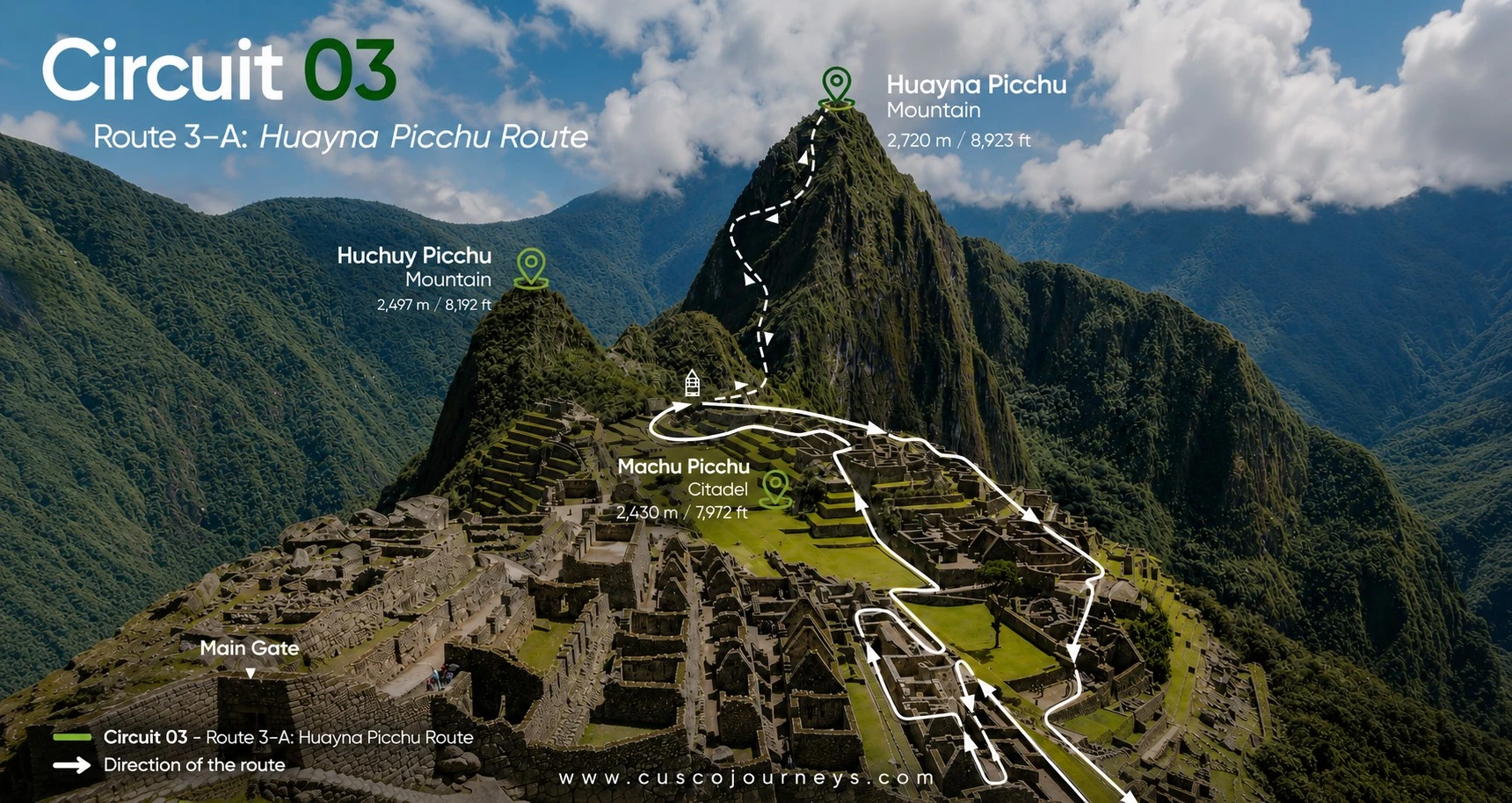 The climb is steep in some sections and requires good physical preparation. From the mountain, travelers can enjoy a different perspective of Machu Picchu and the surrounding Andes.
The route includes important areas such as:
- Temple of the Sun
- Inca House sector
- Sacred Rock
- Twelve Openings
- Eastern Storehouses
- Water Mirrors
- Temple of the Condor
- Pisonay Square
- Archaeological Reserve
- Huayna Picchu Mountain
Why Choose Route 3-A?
Choose this route if you want to combine Machu Picchu with a challenging mountain hike.
It is especially suitable for travelers who enjoy active experiences and want a different perspective of the citadel.
If your priority is the hike to Huayna Picchu, this is the Circuit 3 route to consider.
Route 3-B: Designed Route
Route 3-B is the most straightforward option within Circuit 3. It focuses on archaeological areas of the royal and lower sectors without adding a major mountain ascent.
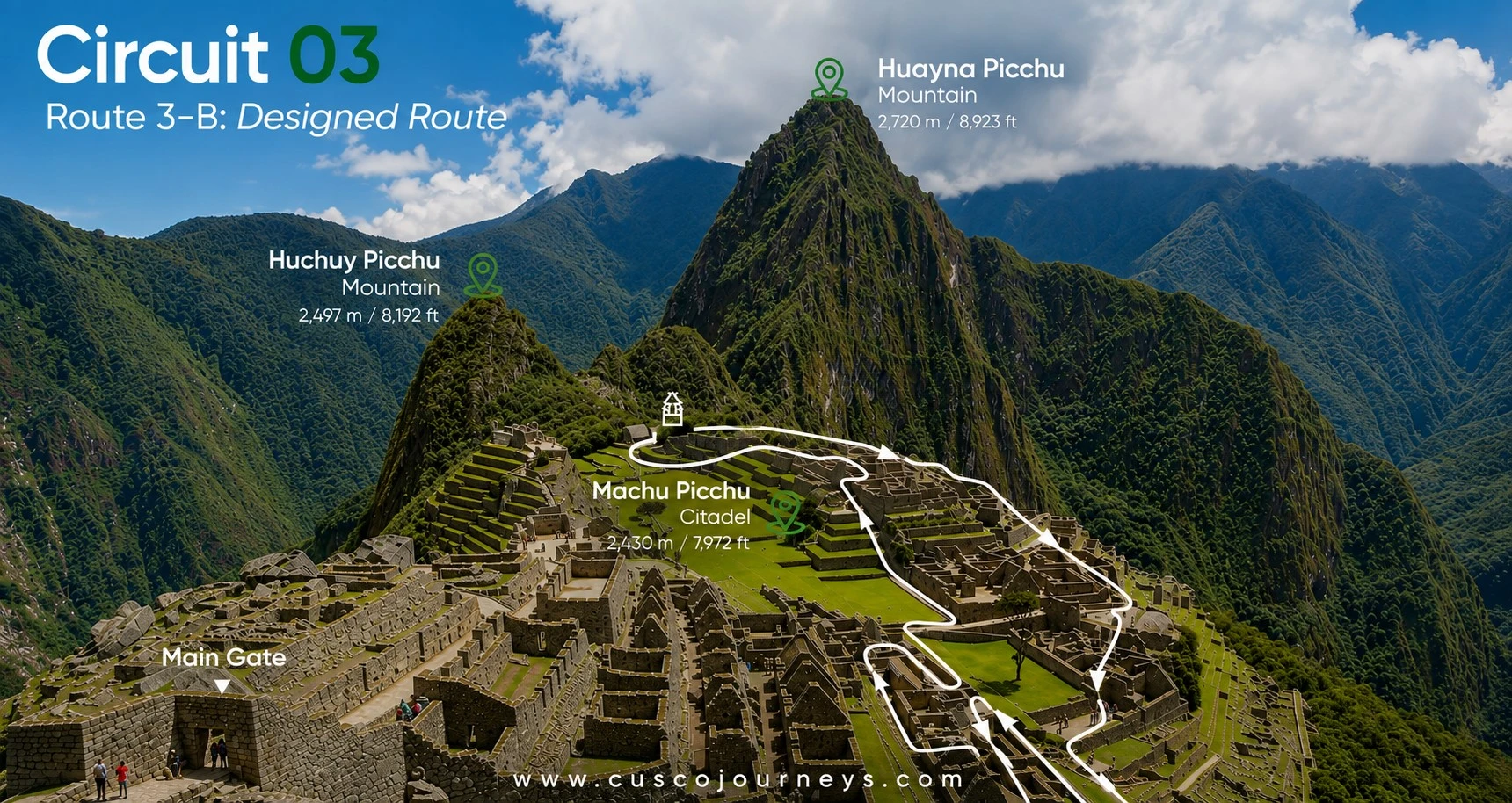 It is a good choice for travelers who want to explore Machu Picchu at a more relaxed pace.
The route includes important areas such as:
- Temple of the Sun
- Inca House sector
- Twelve Openings
- Eastern Storehouses
- Water Mirrors
- Temple of the Condor
- Pisonay Square
- Archaeological Reserve
Why Choose Route 3-B?
Route 3-B is ideal if you:
- Prefer archaeology over hiking.
- Want a more relaxed visit.
- Do not want to climb Huayna Picchu.
- Want to explore the royal sector.
- Are visiting Machu Picchu as part of an Inca Trail experience.
Machu Picchu Circuit 3 and the Inca Trail
Route 3-B is particularly important for travelers arriving from the Inca Trail.
Under the current regulations, visitors coming from the Inca Trail and continuing to Machu Picchu can access Route 3-B according to the approved daily capacity. A limited number of tickets are reserved for Inca Trail visitors and must be reserved and paid through authorized agencies.
If you are planning a 4-day Inca Trail or a 2-day Inca Trail, your Machu Picchu entrance should be coordinated with your trek before your trip.
This is especially important because your route and entrance conditions depend on the current regulations and available capacity.
Route 3-C: Great Cavern
Route 3-C is one of the most adventurous options within Machu Picchu Circuit 3.
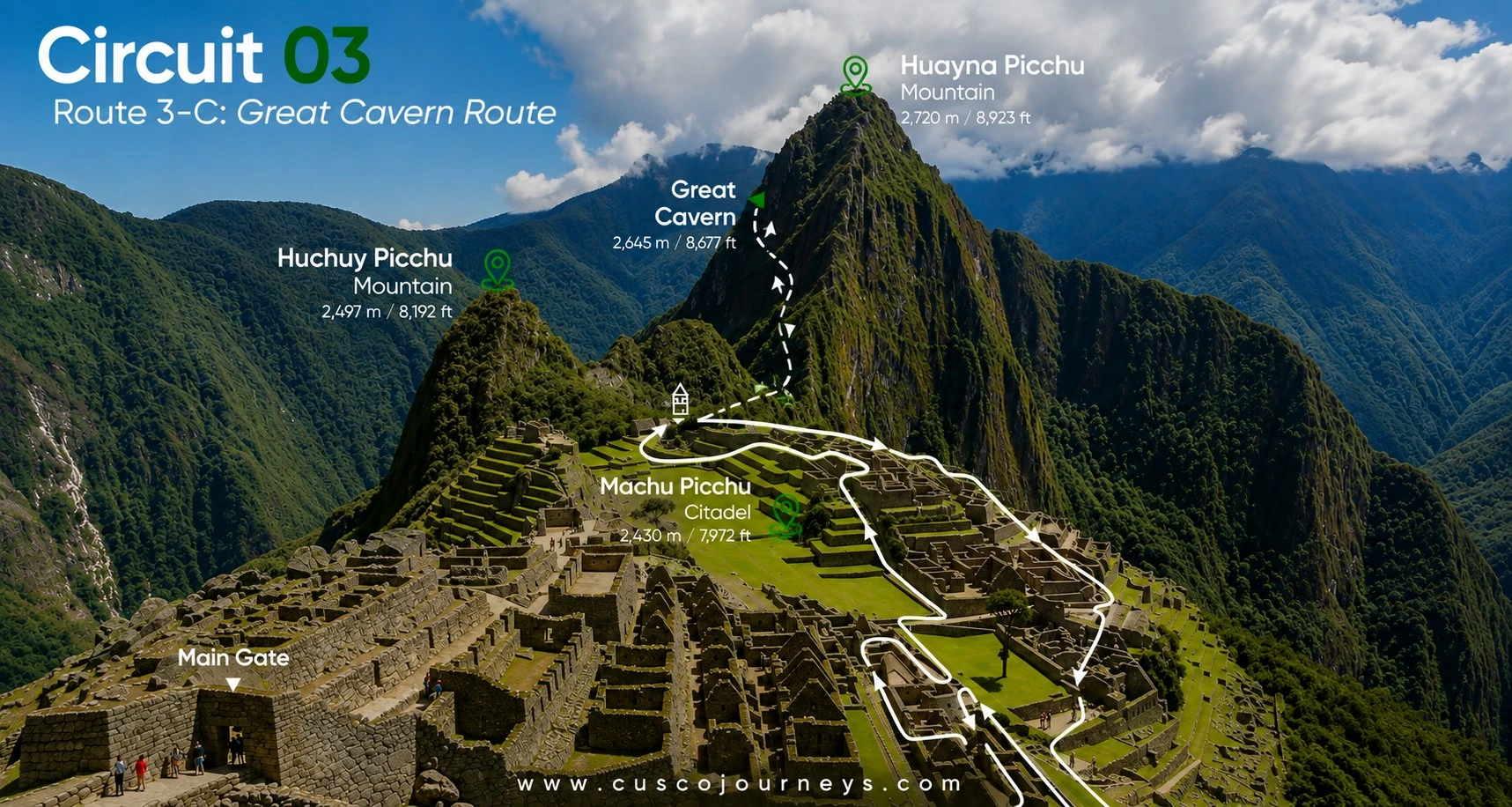 It combines archaeological exploration with a longer hike toward the Great Cavern. The official route allows a maximum stay of 7 hours, making it one of the longest experiences within Circuit 3.
The route includes:
- Lower Platform
- Upper Platform
- Dry Moat
- Temple of the Sun viewpoint
- Granite Chaos
- Temple Plaza
- Intihuatana Pyramid
- Sacred Rock
- Twelve Openings
- Eastern Storehouses
- Water Mirrors
- Temple of the Condor
- Pisonay Square
- Archaeological Reserve
- Great Cavern
Route 3-C is available only during the official high season.
Choose this route if you enjoy hiking and want a longer and more adventurous experience.
Route 3-D: Huchuy Picchu
Route 3-D combines the archaeological experience with an ascent to Huchuy Picchu Mountain.
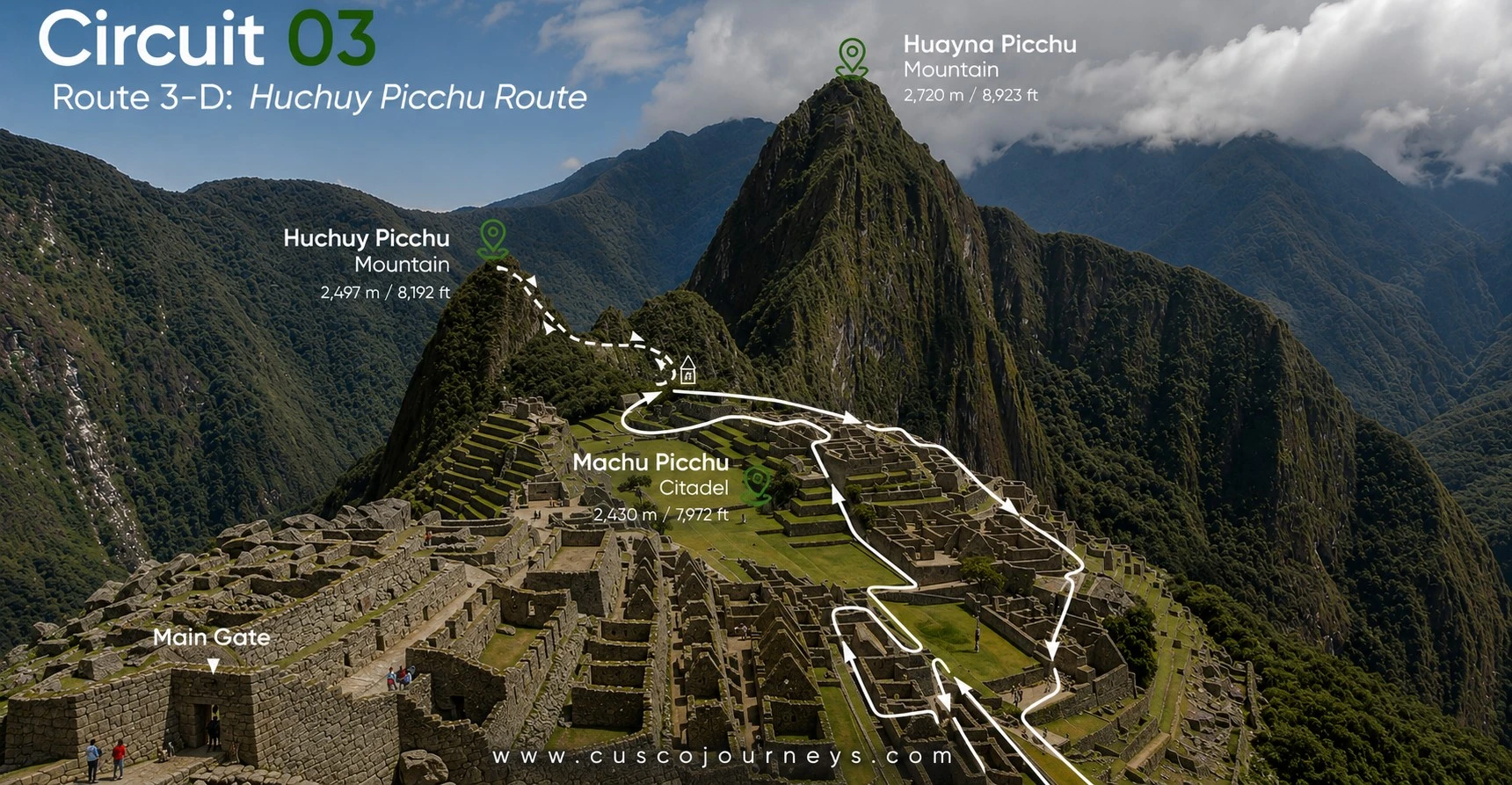 Huchuy Picchu offers a different perspective of the surrounding landscape and is a good option for travelers who want to add a mountain hike to their visit.
The route includes
- Temple of the Sun
- Inca House sector
- Sacred Rock
- Twelve Openings
- Eastern Storehouses
- Water Mirrors
- Temple of the Condor
- Pisonay Square
- Archaeological Reserve
- Huchuy Picchu Mountain
Route 3-D is available only during the official high season.
Choose this route if you want a combination of archaeology, hiking, and mountain views.
Does Circuit 3 Include the Classic Machu Picchu View?
This is one of the most important things to understand before buying your ticket.
Circuit 3 is not the best choice if your main priority is the classic panoramic postcard view of Machu Picchu from the upper terraces.
Circuit 3 focuses on the royal and lower sectors of the archaeological site. Its mountain routes provide different perspectives, but they should not be confused with the classic panoramic viewpoint.
If the traditional Machu Picchu photograph is your priority, compare Circuit 3 with the routes available under Circuit 1 and Circuit 2 before purchasing your ticket.
Which Machu Picchu Circuit 3 Route Should You Choose?
Your ideal route depends on the type of experience you want.
Choose Route 3-A for Huayna Picchu.
Best for travelers looking for adventure and a challenging mountain hike.
Choose Route 3-B for archaeology.
Best for travelers who prefer a more relaxed visit focused on the royal and lower sectors.
Choose Route 3-C for the Great Cavern.
Best for experienced hikers looking for a longer adventure during high season.
Choose Route 3-D for Huchuy Picchu.
Best for travelers who want archaeology combined with a shorter mountain experience.
How Long Does Machu Picchu Circuit 3 Take?
The duration depends on the route you choose.
Route 3-C allows a maximum stay of 7 hours according to the official route information.
The other routes have different visiting conditions and maximum times. Your entrance ticket and the regulations applicable to your travel date determine the conditions of your visit.
For this reason, always check the information associated with your ticket before entering Machu Picchu.
How to Buy Machu Picchu Tickets
Machu Picchu tickets are sold through the official ticketing system.
For 2026, the Ministry of Culture confirms that ticket sales are handled through tuboleto.cultura.pe.
Before purchasing, carefully check:
- Circuit number
- Route
- Date
- Entrance time
- Visitor category
- Route availability
Do not choose a ticket based only on the circuit number. Circuit 3 has four different routes, and each provides a different experience.
For travelers who prefer assistance with their itinerary, tickets can also be coordinated through an authorized travel agency.
Machu Picchu Circuit 3 Prices
Ticket prices vary depending on the route and visitor category. The following are the official rates for foreign visitors in 2026.
Circuit 3 Route |
Foreign Adult |
Foreign Student |
Child (3–17 years) |
|---|---|---|---|
| Route 3-A: Huayna Picchu Mountain | S/ 200 | S/ 125 | S/ 118 |
| Route 3-B: Designed Route | S/ 152 | S/ 77 | S/ 70 |
| Route 3-C: Great Cavern | S/ 200 | S/ 125 | S/ 118 |
| Route 3-D: Huchuy Picchu | S/ 152 | S/ 77 | S/ 70 |
Important: Ticket prices are set by the Peruvian Ministry of Culture. Routes 3-C and 3-D are available only during the official high season, while availability and entrance conditions depend on the route and travel date.
Machu Picchu Circuit 3 Availability
Some routes within Circuit 3 have limited capacity.
For 2026, the Ministry of Culture established a maximum capacity of 5,600 visitors per day on specific high-demand dates, including January 1, April 2–5, June 19–November 2, and December 30–31.
Limited-capacity routes can become difficult to secure during popular travel periods.
If you already know your travel dates, booking in advance is the safest approach.
Best Time to Visit Machu Picchu Circuit 3 in 2026
The best time to visit Machu Picchu Circuit 3 depends on the route you choose and the type of experience you prefer. The dry season, from May to October, generally offers better conditions for hiking, clearer skies, and more comfortable trails.
The rainy season, from November to April, brings more frequent rainfall and greener landscapes. Trails can become wet and slippery, but the surrounding mountains are often especially lush and atmospheric.
Dry Season (May – October) |
Rainy Season (November – April) |
|
|---|---|---|
| Weather | Drier conditions and clearer skies | More frequent rain and cloud cover |
| Hiking | Generally better trail conditions | Trails can be wet and slippery |
| Landscapes | Clearer mountain views | Greener landscapes and mist |
| Crowds | Higher visitor demand | Generally quieter periods |
| Photography | Better chance of clear mountain views | Dramatic clouds and lush scenery |
| What to Bring | Sun protection and light layers | Rain jacket and waterproof footwear |
Important: Routes 3-C Great Cavern and 3-D Huchuy Picchu are seasonal routes. Check their availability for your travel date before purchasing your ticket. The official 2026 capacity schedule distinguishes between regular and high season.
What to Bring for Circuit 3
Your packing list depends on the route you choose, especially if you plan to hike.
We recommend bringing:
- Original passport
- Machu Picchu entrance ticket
- Comfortable hiking shoes
- Small backpack
- Reusable water bottle
- Sun protection
- Hat or cap
- Rain jacket or poncho
- Insect repellent
- Camera or phone
Machu Picchu Circuit 3 Travel Tips
1. Choose your route before buying your ticket.
Circuit 3 includes four different experiences.
2. Know what view to expect.
Circuit 3 does not focus on the classic panoramic viewpoint.
3. Book early for limited-capacity routes.
Huayna Picchu and seasonal routes can have limited availability.
4. Coordinate the Inca Trail and Machu Picchu entrance.
This is especially important for travelers arriving through the Inca Trail.
5. Check current regulations before traveling.
Visitor rules and capacity can change.
6. Prepare for changing weather.
Sun, rain, and clouds can occur during the same day.
7. Choose according to your physical condition.
Some routes involve significantly more hiking than others.